
Five animals. Five legends. Five encounters that, once experienced, redefine your understanding of what it means to share a planet with something truly wild.
Introduction
There is a reason the Tanzania Big Five safari have captivated explorers, naturalists, hunters, photographers, and travellers for well over a century. The lion, leopard, elephant, buffalo, and rhinoceros are not simply large animals. They are presences — creatures of such power, intelligence, and elemental beauty that an encounter with any one of them leaves a mark that time does not easily erase. To seek all five in a single journey is to undertake one of the most compelling pursuits in the natural world.
Tanzania is, without question, one of the finest Big Five safari destinations on Earth. Its extraordinary mosaic of ecosystems — from the endless golden plains of the Serengeti to the volcanic bowl of the Ngorongoro Crater, the elephant-dense woodlands of Tarangire, the remote wilderness of Ruaha, and the riverine forests of the Selous — shelters thriving populations of all five species within a single country. In some locations, encounters with multiple members of the Big Five in a single game drive are not exceptional. They are expected.
The term “Big Five” was originally coined by big game hunters in the nineteenth century to describe the five most dangerous animals to hunt on foot — a designation that reflected the mortal risk these creatures posed rather than their size alone. Today, the Big Five concept has been entirely reclaimed by the photographic safari industry, where the challenge is no longer a rifle but a camera lens, and the triumph is not a trophy but a memory. The pursuit, however, retains its primal electricity. Tanzania is where that pursuit reaches its fullest, most magnificent expression.
This guide explores each member of the Big Five in depth, examines the best Tanzanian destinations for encountering them, and provides everything you need to plan an extraordinary Big Five safari of your own.
The Big Five: An Introduction to Each Species
The Lion — Africa’s Apex Icon
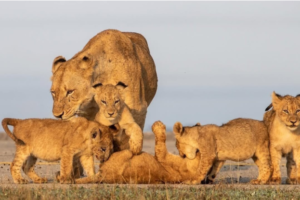
No animal defines the African safari experience more completely than the lion. Tanzania is home to approximately 14,000 to 15,000 lions — roughly 40% of Africa’s total remaining lion population — making it the single most important country on the continent for the species’ survival. The Serengeti ecosystem alone supports one of the largest and most studied lion populations in the world, with prides ranging from intimate family units to sprawling coalitions of up to thirty individuals.
Lions in Tanzania offer safari encounters of extraordinary quality. The open grasslands of the Serengeti allow for prolonged, unobstructed observation of pride dynamics — cubs at play, coalitions patrolling territory, and the dramatic, cooperative hunts that unfold at dawn and dusk across the golden savannah. The Ngorongoro Crater’s self-contained ecosystem supports an unusually dense lion population, and encounters here — sometimes just metres from the vehicle — are among the most intense wildlife experiences in Africa.
What makes Tanzanian lion encounters particularly remarkable is the animals’ familiarity with safari vehicles. Decades of habituated coexistence with non-threatening human observers has produced lions across the northern and southern circuits who are entirely comfortable in close proximity to vehicles — allowing the kind of sustained, intimate observation that defines world-class safari guiding.
The Leopard — The Ghost of the Savannah
Of all the Tanzania Big Five safari the leopard is the most elusive, the most solitary, and — for many experienced safari travellers — the most coveted. Tanzania’s leopard population is healthy and distributed across a wide range of habitats, but the leopard’s fundamentally secretive nature means that a quality sighting remains genuinely special, even in destinations where the animals are relatively habituated.
The Serengeti is Tanzania’s premier leopard destination, particularly the rocky kopje country of the central Seronera region where leopards are well habituated to vehicles and regularly observed in the acacia trees that line seasonal river courses. Dawn and dusk are the optimal viewing periods, when leopards are most active — descending from their arboreal resting places to drink, patrol, and hunt.
The Ruaha National Park in southern Tanzania also supports excellent leopard populations, and the remote, less-visited nature of the landscape means that sightings here, though potentially rarer, carry an exceptional quality of solitude and authenticity. Walking safari encounters with leopard signs — scratch marks on a termite mound, a kill hoisted high into a sausage tree — add a dimension of tracking intimacy unavailable on vehicle-based game drives.
The Elephant — The Continent’s Greatest Land Animal
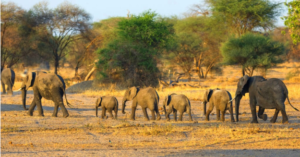
Tanzania is home to one of Africa’s largest remaining elephant populations, with an estimated 60,000 to 70,000 individuals distributed across the country’s national parks, game reserves, and wildlife management areas. The sight of a large elephant herd moving across the Tanzanian landscape — matriarchs leading calves through ancient migration corridors worn into the earth over millennia — is one of the most emotionally powerful experiences in wildlife travel.
Tarangire National Park is Tanzania’s premier elephant destination, particularly between July and October when drought conditions concentrate hundreds — sometimes thousands — of elephants around the Tarangire River. Scenes of elephant families at the river — calves splashing in the shallows, bulls sparring in the mud, matriarchs standing sentinel at the bank — represent some of the most visually magnificent wildlife spectacles in Africa.
Ruaha and the Selous in southern Tanzania support enormous elephant populations that have recovered significantly from the devastating poaching crisis of the 1980s and 1990s, a conservation success story of which Tanzania can be genuinely proud. Bull elephants in these southern parks — old, enormous, and magnificently tusked — are among the most impressive individuals remaining in Africa.
The Buffalo — The Most Underestimated of the Five
The African buffalo is the most frequently underestimated member of the Big Five by first-time safari travellers, who often dismiss it as simply a large cow. Experienced guides and longtime safari enthusiasts know better. The Cape buffalo is an animal of considerable intelligence, complex social structure, and — when threatened or cornered — genuinely dangerous volatility. It is not called “Black Death” by the professional hunting fraternity without reason.
In Tanzania, buffalo are encountered in enormous herds that rank among the most spectacular ungulate aggregations in Africa. The Serengeti supports herds of several hundred to several thousand individuals that move across the plains in rolling black masses, their broad, sweeping horns and perpetually suspicious eyes creating an atmosphere of contained, collective power. The Ngorongoro Crater shelters a particularly dense buffalo population, and the crater’s enclosed geography means that encounters — sometimes within metres of the vehicle — are intimate and sustained.
Buffalo are also significant ecological actors in Tanzania’s landscapes: their grazing patterns shape vegetation structure, their wallows create microhabitats for other species, and their calves are a primary prey source for the lion prides that follow and shadow the great herds across the savannah.
The Rhinoceros — The Rarest and Most Precious of the Five
The black rhinoceros is Tanzania’s rarest and most precious Big Five member — and completing the Big Five here requires knowing precisely where to look. Tanzania’s rhino population has recovered from the catastrophic poaching losses of the 1970s and 1980s, but numbers remain critically low compared to the species’ former range. The country’s primary stronghold for black rhino is the Ngorongoro Crater, which shelters an intensively protected population of approximately twenty to thirty individuals — making a crater floor game drive the most reliable opportunity for a rhino sighting in Tanzania.
The Ngorongoro rhinos are among the most closely monitored wild animals in Africa, with dedicated ranger units providing round-the-clock protection. Sightings of these ancient, prehistoric-looking animals — moving with surprising speed across the crater floor, their distinctive hooked lips browsing on scrubby vegetation — carry an emotional weight that goes beyond mere wildlife observation. You are looking at one of the most endangered large mammals on the planet, in one of the last places it still roams free.
Additional rhino populations are found in the Serengeti National Park and in Mkomazi National Park in northern Tanzania, where a black rhino sanctuary established in partnership with international conservation organisations is contributing to population recovery efforts.
Best Destinations for Tanzania Big Five Safaris
Ngorongoro Crater — The Most Reliable Big Five Location
For travellers whose primary goal is completing the Big Five in a single location, the Ngorongoro Crater is Tanzania’s most reliable destination. The crater’s enclosed ecosystem and remarkably high wildlife density — lions, leopards, elephants, buffalo, and black rhinos all inhabit this 260-square-kilometre bowl — means that a dedicated two-day crater experience, with full days on the crater floor, offers the highest probability of encountering all five species.
The crater’s geography works in the safari traveller’s favour: animals cannot easily leave, water sources are limited and predictable, and the open floor provides excellent visibility across most of the year. For Big Five completionists, Ngorongoro is the single most important inclusion in a Tanzania itinerary.
Serengeti National Park — Scale and Drama
The Serengeti delivers Big Five encounters on an epic scale — vast lion prides, habituated leopards in riverside acacias, elephant family groups moving through the long grass, buffalo herds of extraordinary size, and small but growing rhino populations in the southern and western zones. The sheer scale of the ecosystem — 14,763 square kilometres of protected land — means that no two Serengeti safaris are alike, and repeated visits consistently produce new and remarkable encounters.
Tarangire National Park — The Elephant Capital
No Tanzania Big Five itinerary is complete without Tarangire, where elephant encounters reach a scale and intimacy unmatched elsewhere in East Africa. The park’s lions are well-habituated and frequently encountered, leopards haunt the river course vegetation, and buffalo herds graze the open floodplains in substantial numbers. While rhino are not present in Tarangire, combining it with Ngorongoro on a northern circuit itinerary covers the full Big Five roster with exceptional depth.
Ruaha National Park — Wild, Remote, and Complete
For the most adventurous and least-compromised Big Five experience, Ruaha in southern Tanzania delivers all five species — including a small but recovering rhino population — in a landscape of profound remoteness and raw ecological integrity. Ruaha’s professional walking safari operators bring an additional dimension to Big Five pursuit: tracking on foot, interpreting signs and spoor, and approaching animals through the bush with a skilled ranger — an experience of unmatched intimacy and genuine wilderness immersion.
Planning Your Tanzania Big Five Safari
Optimal Timing
The dry season (June to October) remains the optimal period for Big Five game viewing across most of Tanzania, as reduced vegetation and concentrated water sources make wildlife more visible and predictable. For the Ngorongoro Crater specifically, the crater floor is accessible year-round, though the dry season offers the clearest conditions and the most reliable wildlife concentration. Tarangire’s legendary elephant gatherings peak between July and October — the most important months for visitors whose priority is large elephant herds.
Duration
A dedicated Tanzania Big Five safari requires a minimum of seven to ten days on the ground to cover the key northern circuit destinations — Tarangire, Ngorongoro, and the Serengeti — with sufficient time in each location for meaningful wildlife encounters. Adding Ruaha via domestic flight extends the experience into southern Tanzania’s remarkable wilderness and significantly increases the depth and diversity of the Big Five encounters achievable within a single itinerary.
Guiding Quality
Big Five safari success is inseparably linked to guide quality. An expert Tanzanian naturalist can read the landscape for signs that an inexperienced eye would miss entirely — a flicker of movement in a kopje that resolves into a resting leopard, the particular stillness of a lion that signals imminent hunting behaviour, the fresh rhino tracks that redirect a morning game drive toward one of Africa’s rarest encounters. Investing in the best available guiding — through private vehicle hire or the selection of operators with strong guide reputations — is the single most impactful decision a Big Five safari traveller can make.
Key Takeaways
- Tanzania holds approximately 40% of Africa’s remaining lion population, making it the single most important country on the continent for lion conservation and the premier destination for quality lion encounters.
- The Ngorongoro Crater is Tanzania’s most reliable Big Five location — its enclosed ecosystem and exceptional wildlife density offer the highest probability of encountering all five species in a single extended visit.
- Tarangire National Park is Africa’s elephant capital during the dry season, when hundreds to thousands of elephants converge on the Tarangire River in one of the continent’s most spectacular wildlife spectacles.
- The black rhinoceros is Tanzania’s rarest Big Five member — with the Ngorongoro Crater’s carefully protected population of twenty to thirty individuals representing the best and most reliable opportunity for a rhino sighting in the country.
- The leopard is the most challenging of the five to observe well — habituated individuals in the Serengeti’s Seronera region offer the best quality sightings, particularly at dawn and dusk in riverside acacia habitat.
- A minimum of seven to ten days is recommended for a dedicated northern circuit Big Five itinerary; adding Ruaha via domestic flight extends coverage into southern Tanzania’s exceptional and less-visited Big Five habitat.
- Guide quality is the most important variable in Big Five safari success — an expert naturalist transforms wildlife signs invisible to the untrained eye into extraordinary, targeted encounters.
Questions & Answers
Q: Is it realistic to see all five of the Big Five on a single Tanzania safari? A: Yes — and Tanzania is one of the best places in Africa to achieve it. A well-planned itinerary combining the Ngorongoro Crater (essential for rhino), the Serengeti (lion, leopard, elephant, buffalo), and Tarangire (elephant, lion, leopard, buffalo) gives travellers an excellent probability of encountering all five species. The Ngorongoro Crater is the key variable — it is Tanzania’s only location with a reliable and accessible rhino population, and including a minimum of two full days on the crater floor is essential for a realistic Big Five completion attempt.
Q: Which of the Big Five is hardest to see in Tanzania? A: The black rhinoceros is unambiguously the most challenging, due to the critically low population size across the country. Even within the Ngorongoro Crater — Tanzania’s best rhino destination — sightings are not guaranteed, and the animals’ naturally wary behaviour and preference for dense vegetation means patience and a skilled guide are essential. The leopard is a close second in difficulty, owing to its solitary, secretive nature and predominantly nocturnal activity patterns. Quality leopard sightings in Tanzania’s national parks, where night drives are generally prohibited, require careful timing, excellent guiding, and a degree of fortune.
Q: What is the best time of year for a Big Five safari in Tanzania? A: The dry season from June to October is widely considered the optimal period for Big Five game viewing across Tanzania. Reduced vegetation, concentrated water sources, and predictable wildlife movement patterns during this period maximise encounter frequency and quality for all five species. For elephants specifically, the July to October window in Tarangire is exceptional. The Ngorongoro Crater offers reliable Big Five potential year-round, with the dry season providing the clearest conditions and greatest wildlife concentration on the crater floor.
Q: Can children participate in a Tanzania Big Five safari? A: Yes — Tanzania’s national parks welcome children of all ages on vehicle-based game drives, and a Big Five safari is an exceptional wildlife education experience for young people. Children typically respond to Big Five encounters — particularly lions and elephants — with a wonder and engagement that enriches the experience for the entire group. For walking safari components (available in Ruaha and Selous), most operators impose a minimum age of twelve to sixteen years for safety reasons. Private vehicle hire is strongly recommended for families with young children, providing the flexibility to adjust game drive timing and duration based on the group’s energy and attention.
Q: How does Tanzania compare to other African countries for Big Five safaris? A: Tanzania ranks among the top two or three Big Five destinations in Africa, alongside South Africa’s Kruger National Park ecosystem and Kenya’s Masai Mara. Tanzania’s key advantages are the sheer scale and ecological integrity of its protected areas, the extraordinary abundance of lion and elephant, and the presence of genuinely remote wilderness destinations — Ruaha, Selous, Mahale — that offer Big Five encounters entirely away from mass-tourism circuits. South Africa offers certain logistical advantages (self-drive accessibility, white rhino abundance) and Kenya shares the Serengeti ecosystem across the Masai Mara border, but Tanzania’s combination of wildlife diversity, conservation commitment, and landscape magnificence places it at the very summit of Big Five safari destinations worldwide.
Conclusion
The Tanzania Big Five safari is not a checklist. They are not a competition, a score to be tallied, or a box to be ticked before the flight home. They are, at their deepest level, five invitations — to look more carefully, to sit more quietly, to abandon the human preoccupation with control and agenda and simply be present in a landscape that has been hosting extraordinary life for millions of years longer than our species has existed.
Tanzania accepts you into that landscape with an openness and generosity that is difficult to fully describe until you have experienced it. The lion that walks past your vehicle without acknowledgement. The elephant matriarch that pauses, ten metres away, and regards you with an intelligence and gravity that feels uncomfortably familiar. The leopard that descends from its acacia tree at dusk and disappears into the grass as completely as if it were made of shadow. The buffalo herd that fills the horizon from one end to the other. The rhino — ancient, prehistoric, impossibly rare — moving alone across the crater floor in the early morning light.
These are the moments that Tanzania offers. Five animals. Five encounters. A single journey that changes the way you understand wild things — and, perhaps, the way you understand yourself.